Showing posts with label roll out. Show all posts

Saturday, September 10, 2011

Believe It or Not, The Balanced Embouchure is Not an Embouchure!


In brass embouchure pedagogy, the usual training involves being told how to correctly place the mouthpiece and lips to play, such as einsetzen, ansetzen, 2/3 - 1/3, etc.  Because of this context, when horn players hear of The Balanced Embouchure, they often assume it's another prescribed embouchure setting.  And, because BE claims to work for everyone, horn players often doubt this claim knowing that there is no one "correct" embouchure setting that works for everyone.  Here's an example.  A thoughtful comment was recently left on James Boldin's blog that includes this sentence:

Being that there are anatomical differences from person to person, I don’t see how it is possible for one way to be “the right way." 

If the writer of this statement believes BE is promoted as a "correct" embouchure setting that works for everyone, I agree that it's impossible to be "the right way."  Fortunately that's not what BE is.  In fact, theory and practice, BE is quite the opposite.  BE is not an embouchure; BE is a set of well designed exercises that develop every embouchure. 

One of the specific reasons BE works for everyone, is that it is not a prescribed, one-size-fits-all, embouchure setting.  The application of BE to the embouchure is as unique as each brass player's anatomy.  There are no instructions in the BE book that say, "set your lips this way for the upper register", "drop your jaw for low notes," "frown for the high register," etc.  The only specific instructions in BE are how to set the lips for executing the BE exercises, not for regular playing.

BE exercises "work" by extending the brass player's range of motion in directions and to degrees most would never imagine.  In this ability stretching process, the intuitive brass player consciously and unconsciously finds positions, techniques, movements, lip shapes, etc. that can be applied to his/her embouchure.  Jeff Smiley recognizes that the individual brass player is the one best suited to determine what does and doesn't "work" when that individual is given good tools to guide their choices.  (See: I Am Not a Guru.)

See also:  Why BE Works

Friday, July 22, 2011

EXTREME EMBOUCHURES!


Can you hear the cheesy radio/TV ad announcer attempting to increase adrenalin levels with: "EXTREME demolition derby!" "EXTREME sports!" "EXTREME thrills!"  Hmmm.... How about a cheesy announcer to say...

"EXTREME embouchure exercises!"

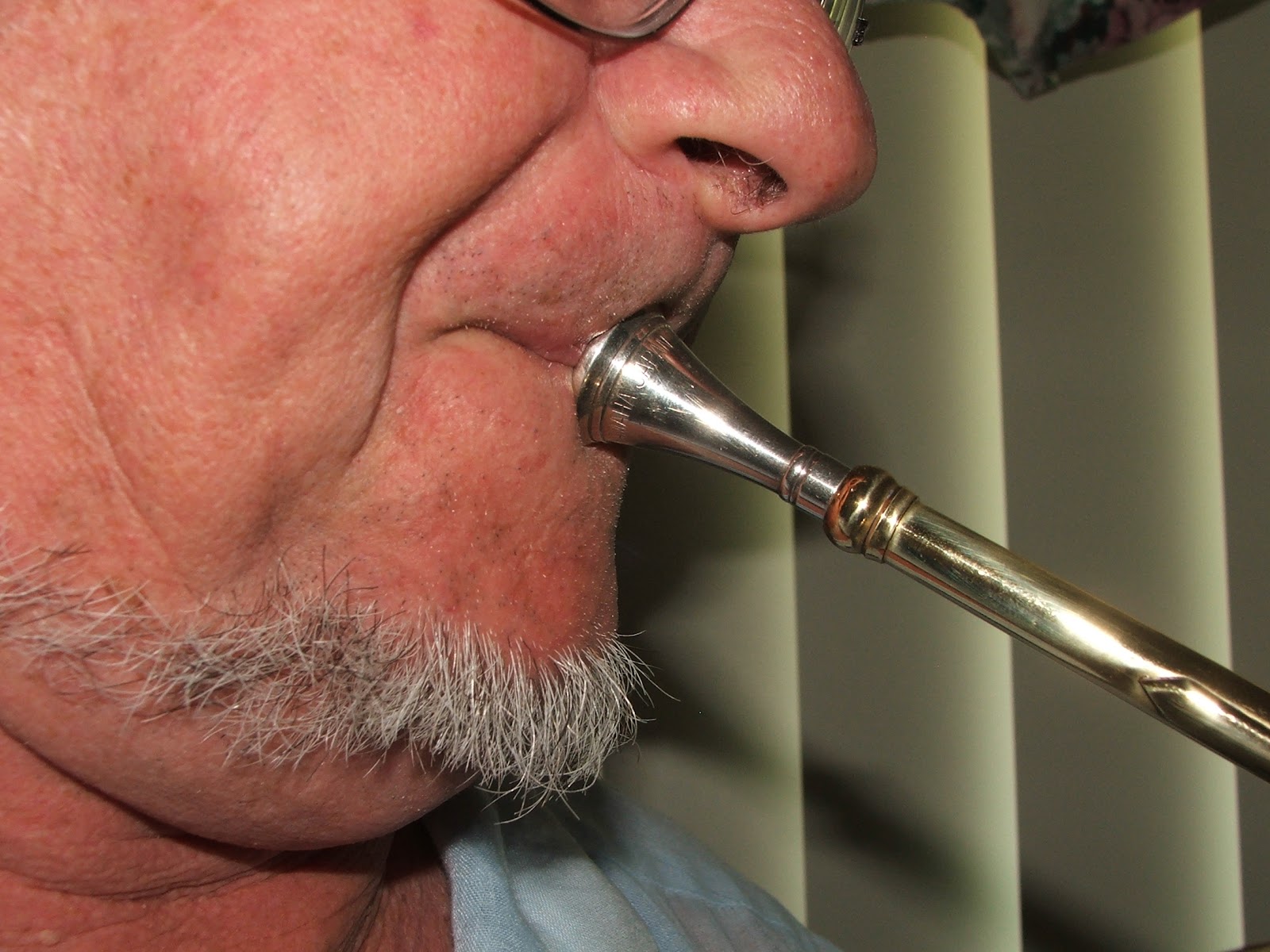
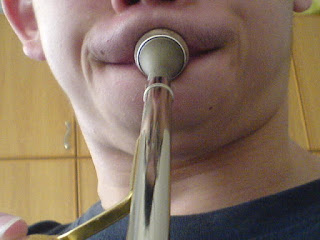
These are still shots of the extreme embouchure settings I use when I practice some of the BE exercises. This is how it works for me:

(1) If I can develop tone, range and facility in an extreme embouchure; then tone, range and facility with a "normal" embouchure will be easier.

(2) If I can learn to play in both extremes, I'm bound to find settings between the extremes that work well for me.

(3) If I systematically practice in the extremes as well as transitioning from one extreme to the other, I'll eventually learn maneuvers I can use to navigate efficiently within the less extreme registers I encounter in daily playing.

Works for me!
Also see:  Why the Extremes?
Also see: "Circus Trick" or Developmental Tool?

-----------------------

The roll-out and roll-in exercises can be performed "correctly" with or without air pockets as seen in the examples contributed by horn players here. Air pockets are an option, not a requirement in BE. Some people can't do the exercises without them; others can't do the exercises with them. It's an individual thing and nothing to stress over either way. I like practicing with air pockets as pictured, because it helps me isolate and control individual muscle groups to play with less overall tension.
--------

"Don't hate me because I'm beautiful!"
-------
Cute comment from Iris: Thanks, Valerie— these pictures are great! I was just joking earlier this week with my daughter (an accomplished trumpet player) that everyone would want to try BE if it was called "X-treme Embouchure!" The photos also helped to show me that I'm on the right track with my goofy-faced ROs and RIs! ~Iris 
----------


If one picture is worth a thousand words, then multiply that by what you see here!


Wednesday, July 20, 2011

"Circus Trick" or Developmental Tool?

On Yahoo Horn, Aleks wrote:
I suspect that your understanding of an einsetzen embouchure has been dictated by trumpet players who roll their lower lip out and put it practically outside the mouthpiece cup to play pedal tones. This is not an einsetzen embouchure, but a circus trick.
Aleks, Thank you so much for your comment. You may call this a "circus trick", because you aren't aware of its value and use to the brass player. I would also call it a "circus trick" if I didn't have positive experience using it. I will agree that it has little or no direct application in regular performance, but I do regard this technique as a valuable tool for embouchure development. I liken it to buzzing, which also seems useless to those who have never used it systematically. No one actually performs free buzzing or buzzing the mouthpiece alone, but this is never-the-less a valuable development tool for many.

The technique of playing with the lower lip completely rolled out below the mouthpiece rim, which I consider an exaggerated or extreme form of einsetzen, is the foundation of the roll out exercises in the Balanced Embouchure system. Trumpet players and horn players alike use this technique to help them develop their embouchures. Those who have benefited from this development tool, are very grateful for this "circus trick!" Here are links to one horn player's positive experience working with this exercise:

http://beforhorn.blogspot.com/2011/02/discovery-and-experience.html
http://beforhorn.blogspot.com/2010/06/just-got-this-today.html

Also on Yahoo Horn, Richard Hirsch defined einsetzen as one in which the mouthpiece is set into & stays in the lower lip. After thinking about this, I realized that his definition closely describes the activity of one particular BE exercise (RO#4) which I practice daily. This exercise employs this set up to develop the ability to play the fullest range possible while keeping the rim of the mouthpiece set into the lower lip as much as possible -- pretty close to Richard's definition.

There's another set of exercises, the roll-in's, that do the opposite. These start way up high with an exaggerated rolled in set-up, then drag the setting down as far as possible into the lower ranges. This set up, which I believe may be a form of ansetzen, could also be called a "circus trick", because in its most exaggerated form, has no direct application to regular performance. I regard it as a valuable tool for embouchure development, practice it daily, and am pleased with the results.

Working with both extremes of einsetzen (roll-out) and ansetzen (roll-in) on a systematic, daily basis as presented in The Balanced Embouchure, provides comprehensive experiences for discovery that are not part of any other embouchure development system I've seen. These exercises expand the range of motion and abilities of the average brass player far beyond anything most could even imagine possible.

"Everything's impossible until someone does it." --Bruce Wayne

Tuesday, November 30, 2010

Unconscious Control

Here's a new comment to an older post. Thanks, Kenny.

A lot of playing the trumpet is controlled by the subconscious. Think about it for a moment - if we had to have an aperture setting of .015 of an inch high by .015 of an inch in width with 4.7 psi of air pressure and lip compression of .0025 pounds to achieve note X - how could we possibly do this? We could not. It would be physically impossible. We do not posses the conscious control over our bodies in this extreme. Only the subconscious mind can control things on this level. It's like picking up a glass of water. You don't think about how much grip the fingers must exert or how much lift your arm must provide - it just happens because we let it happen. It is learned through feel as there was a time when you were a toddler that picking up a glass of water (or tying your shoes) was quite a challenge; yet we now perform these task on a subconscious level. Thus the reasoning behind Jeff's method - the exaggerated extremes of RO and RI kind of sets where the stops are. Once your mind conceives these stops it then tries to refine the whole range of motion to find ones particular balance point. Some people may have a natural balance that falls in the motion exerted in the RO, some will have it to fall within the RI, some it will be somewhere between. The old saying - get out of the way of the horn and let it play - has merit. Our body wants to achieve the sound concept that we have in our mind if only we will let it.

Kenny Clawson
By clawsonk on I don't get it. on 11/29/10

Friday, October 8, 2010

Looks can Deceive

Here's a splendid example of why we should not try to look like someone else when we play the horn:

Hi Valerie,

When I play I have a RI (rolled in) feel and when I look in a mirror at my embouchure it is still significantly RO (rolled out) . . . and that is up to high F with a
strong sound up to high E! That is weird, but h--- it works ;-)

Guillaume

Comment from Jonathan West:

I've had discussions with Lyle Sanford that touch on this issue. In orchestra rehearsals, conductors talk about what they want from the strings in terms of tone. They describe the techniques to be used - heel or tip of the bow, pressure vs bow speed, start on or off the string. Likewise percussionists have a well-established vocabulary for their techniques - stick speed and weight, whereabouts on the surface to strike the drum, hardness of stick etc. But for wind players, there isn't that same vocabulary of techniques. The vocabulary is more about effects than techniques. This is because what goes on for a wind player is internal (air support, tonguing etc) or consists of minute outwardly imperceptible changes around the lips. And I rather suspect that everybody visualises what is going on internally and with the lips a bit differently - and almost all the visualisations are wrong to some degree. This is probably why, if BE works for you, you can't quite tell why or how. What you See more... think is going on is probably different from what is really going on. But that doesn't matter all that much. What matters is whether the visualisation involved works for you!
By Jonathan West on Looks can Deceive on 10/14/10

Monday, April 26, 2010

Decisions, Decisions....

Several great questions came from a Doug, a three month BE’er:

"Is there some point in time or development where you're supposed to start moving from RO to RI as you ascend?"
Yes, as soon as you learn the RO and RI exercises you should begin practicing the Advanced Slip slurs to start the process of bridging the gap. The goal is a "continuous flex" as we ascend with no breaks. However, this goal comes from a trumpet player. Trumpet players strive for a no break, no reset embouchure and I believe they can achieve it more readily than a horn player. After all, when compared to horn players, trumpet players only have a mid and high range, no low register. Many horn players have a break, or a place where they must switch or shift their embouchure setting to accommodate the requirements of the range. Doug continues,
"I've been working on bringing the playable notes in RO up as high as I can. I think this is an area where I could use some face to face instruction."
I'd love to work with Doug face to face, but I'm not sure I have the answers he seeks.

At this point he has several directions he might move towards:
(1) switching from RO to RI seamlessly somewhere along the way up and vice versa
(2) developing some sort of RO-RI hybride to play the full range
(3) developing a RO that plays the full range
(4) developing a RI that plays the whole range
(5) developing a RI and a RO that significantly overlap to avoid resetting within phrases
and/or....
(6) doing something completely different that I can't even imagine!

The Advanced Lip Slurs are designed to extend the range upwards and downwards step by step so the player can use techniques learned in RO and RI exercises to discover movements to eliminate or minimize awkward "breaks." It's impossible to say where any one player will shift from RO to RI or if they will need to. It will depend on personal architecture as well as the embouchure they start with, playing needs, personal choices, practice habits, etc.

BE students are encouraged to experiment with the extremes of the exercises to help them discover lips shapes and movements to develop more efficient "chops." BE is not like other methods that prescribe mouthpiece placement and exactly what one must do with the lips, the tongue, the teeth, for regular playing. Because BE is based upon universal principles, BE exercises compliment other methods so the BE student is free to explore and investigate other methods. One never knows where an important piece of the embouchure puzzle will be found.

Below is an example of a bold move a fellow horn player on BE recently made to tackle a very challenging situation.


"I have been flirting with BE for over a year with few results--I still can't get a decent RI. When I work on BE, my regular playing suffers, particularly high and soft playing, though TOL has helped that. The problem with my accustomed embouchure is that it is "conditional," and I don't have good endurance. However, a week ago I was faced with a grueling concert last night preceded by a rehearsal. First horn on Gershwin's Cuban Overture, Rhapsody in Blue, and American in Paris, plus I'm rehearsing Tchaikovsky's fifth, which is a lot of high playing, and I'm trying out for the solo. So, a week ago I did what you shouldn't do: I switched to the smaller mouthpiece I use with BE and changed my embouchure to lips together and air pockets behind both lips. Result: I got through the rehearsal and concert with no endurance problems. I could have played another concert. I had more clams than usual--usually when the air pockets collapsed, but the high notes sailed out, as well as the low. Today my chops feel fine.

"This is not a 'BE embouchure,' if there is such a thing, but certainly was influenced by the BE practice.

"It looks like I'm committed. I would expect that BE practice will only help with this setup. Sometimes desperation helps."

I have to disagree that Henry did what he "shouldn't do." I also disagree with his conclusion that this isn't a "BE embouchure." If it worked, it’s correct. And if BE exercises influenced it, then it is a "BE embouchure," no matter what it looks like!

I’ve encouraged Henry to work on this set up & see what he can accomplish with it. If he can make it perform cleanly with a nice tone, why not use it? He can call it his personal BE embouchure! :o)

Through my experiences with BE, I’ve had the privilege of getting well acquainted with some super good horn players. Some use a rolled in setting for the high range and gradually transfer to a more rolled out setting for the low. A few use a rolled in setting for all of their playing, even the low register. Others use a hybride of both roll in and roll out in varying degrees depending on the range. It varies from player to player.

If anyone is dissatisfied with their embouchure, it is important to actively explore as many avenues as possible, even things that seem strange or radical, in our pursuit of one's personal "balanced embouchure."

Monday, April 12, 2010

Knowing, Understanding vs Feeling

I learn so much from my BE horn friends. Read this interesting comment from Gill [italics added].

Dear Val,

Yesterday evening, I went through a nice experience. I was trying a couple of BE things on my trumpet, without any real other aim but having some fun after my day at work, and I suddenly found a lip set up (I'd say, 90% of RO and 10% of RI) which allowed me to hit high Cs one after the other with absolutely no mpc pressure while doing RO#4. I knew from my previous experiments on the horn that I was more of a RO type of player, but up till now it was another kind of RO feeling... Yesterday I felt for the first time the foreward - inward motion of RO up to high C and the
repetition made me feel what happens on low C that I need to drag up so I can climb up there easily.

"Muscles moving toward the mpc while ascending." I surely knew and understood what it was about and I already had a kind of feeling before. But now it's a whole new feeling associated with it. There a huge difference between understanding the principals of embouchure development and feeling them.

You can understand the concepts, but it will be nothing until you feel them in practice, and the path is quite well hidden.

...the one solution: "practice", and the first rule: "BE patient!"

Take care.
Gill


If any of you have a trumpet or another brass instrument, it can be beneficial to experiment on it. Experimenting on an unfamiliar brass instrument removes the elements that are unique to the instrument and gives you the opportunity to isolate and explore the universal principals that BE is based upon. After I'd studied BE on horn for a year or more, I began to experiment with BE on trumpet. I discovered a whole new, extreme technique for double pedals with the lower lip fully outside the mouthpiece. I had read the book, knew & understood the logic behind it, but, like Gill, I hadn't felt it yet. Experiencing the new technique on trumpet introduced me to a whole new feeling that wasn't available to me on horn alone. I was able to transfer the techniques to horn and expand on my range of motion that is so beneficial to development.

Valerie Wells