Showing posts with label einsetzen. Show all posts

Saturday, September 10, 2011

Believe It or Not, The Balanced Embouchure is Not an Embouchure!


In brass embouchure pedagogy, the usual training involves being told how to correctly place the mouthpiece and lips to play, such as einsetzen, ansetzen, 2/3 - 1/3, etc.  Because of this context, when horn players hear of The Balanced Embouchure, they often assume it's another prescribed embouchure setting.  And, because BE claims to work for everyone, horn players often doubt this claim knowing that there is no one "correct" embouchure setting that works for everyone.  Here's an example.  A thoughtful comment was recently left on James Boldin's blog that includes this sentence:

Being that there are anatomical differences from person to person, I don’t see how it is possible for one way to be “the right way." 

If the writer of this statement believes BE is promoted as a "correct" embouchure setting that works for everyone, I agree that it's impossible to be "the right way."  Fortunately that's not what BE is.  In fact, theory and practice, BE is quite the opposite.  BE is not an embouchure; BE is a set of well designed exercises that develop every embouchure. 

One of the specific reasons BE works for everyone, is that it is not a prescribed, one-size-fits-all, embouchure setting.  The application of BE to the embouchure is as unique as each brass player's anatomy.  There are no instructions in the BE book that say, "set your lips this way for the upper register", "drop your jaw for low notes," "frown for the high register," etc.  The only specific instructions in BE are how to set the lips for executing the BE exercises, not for regular playing.

BE exercises "work" by extending the brass player's range of motion in directions and to degrees most would never imagine.  In this ability stretching process, the intuitive brass player consciously and unconsciously finds positions, techniques, movements, lip shapes, etc. that can be applied to his/her embouchure.  Jeff Smiley recognizes that the individual brass player is the one best suited to determine what does and doesn't "work" when that individual is given good tools to guide their choices.  (See: I Am Not a Guru.)

See also:  Why BE Works

Thursday, August 18, 2011

Colin's BE Testimony: A Zero to Hero Experience

To the Memphis horn list, Colin wrote:
Dear Fellows,

I have been following the BE thread with great interest. I hope you do not mind me sharing my recent BE experiences so far.

I am a band instructor and a specialist horn tutor in secondary schools (junior high?). I ordered my BE book months ago (February?) and decided then I was too busy for BE; and I admit that it also seem radical then. I thought I was managing 'well' despite my struggles on my instrument, but recently I am going through both a career change and hence having more time for playing the horn; and I am also being put through a much needed embouchure correction under guidance from a friend who is teaching French horn in Germany. I was struggling with the embouchure change to what that should be proper (flat/pointed chin and einsetzen), and was incapacitated for past couple of weeks.

Having the luxury of time now, and watching with interest the recent BE controversy in the forum, I thought I might as well use the BE method that was collecting dust on my shelf. I have nothing to lose really, so I read carefully and struggled with the roll-out exercise #1 to #3 for one whole day and managed also to effect the lip clamp squeak.

I then went for a rehearsal the next evening not knowing what to expect and tried playing the concert repertoire of about 12 crazy pop pieces with my 'normal and proper' setup. Nothing BE about it, but the facility of the 'normal' embouchure increased many fold. I hop around between 4th horn and 1st horn parts with growing confidence. I enjoyed surprisingly good tone with no distortion, greater flexibility and accuracy; and I can now take my mind off to focus on articulation and more musical expression. It's a very real zero to hero experience for me.

The next evening (which was yesterday), I only did 5 minutes of the roll-out exercises, a clumsy warm up, and used a mouthpiece totally different from what I used the day before. Surprisingly I had the same success with this mouthpiece (which I felt wasn't a good mouthpiece before). The change in the sound, efficiency and facility is equally dramatic but my colleagues observed little or no visible change in my einsetzen setup.

Tomorrow is the 3rd repertoire session -  "Mozart Serenade in C minor," I did nothing today save a couple hours of BE RO exercise #1 to #4 and lip clamp squeaking. I look forward to tomorrow and I am going use the most un-preferred mouthpiece in my inventory.

I have to say I still sound terrible when I struggled with the BE exercises for the 3rd day so far, but when it comes to 'normal' playing, the positive changes is both so dramatic and sudden, I can only attribute it to the effective of the BE program.

It give me back the same sparkle like how I fell in love with horn as a child 25 over years ago.

Hope this testimony is useful

Yours sincerely
Colin Ng
Hornfellow
Singapore
Soon after, I received the following in private email:
Dear Valerie,

I want to say a big thank you to you and Jeff Smiley, but words cannot express the extent of gratitude I am feeling now. All I can say is that the new playing experience is too sudden and too dramatic. It can only be BE.

If I was not brought to standstill and totally zero-ed because of the 'professional' embouchure change, I could not have experienced such dramatic improvement thru BE. The BE brought about what I previously thought would take months to experience through professional help.

Now I feel stupid to have put the book aside months ago then. It was so difficult to accept and understand because of our existing concepts and conventions. But BE is actually a very simple concept, so simple that we get to keep what we have and yet able to excel exceedingly. It's just that we have to approach with the attitude of the dry sponge, or the empty cup to receive and soak up what that was offered compassionately and sincerely.

Do give me a little more time and I hope to bring you more favorable progress report and perhaps seek validation on my BE progress.

Yours sincerely

Colin Ng
Hornfellow
Singapore.
Thanks, Colin for your inspiring words.  To see more of Colin's writings see this or visit his blog:  http://simplysymphonic.wordpress.com/

Friday, July 22, 2011

EXTREME EMBOUCHURES!


Can you hear the cheesy radio/TV ad announcer attempting to increase adrenalin levels with: "EXTREME demolition derby!" "EXTREME sports!" "EXTREME thrills!"  Hmmm.... How about a cheesy announcer to say...

"EXTREME embouchure exercises!"

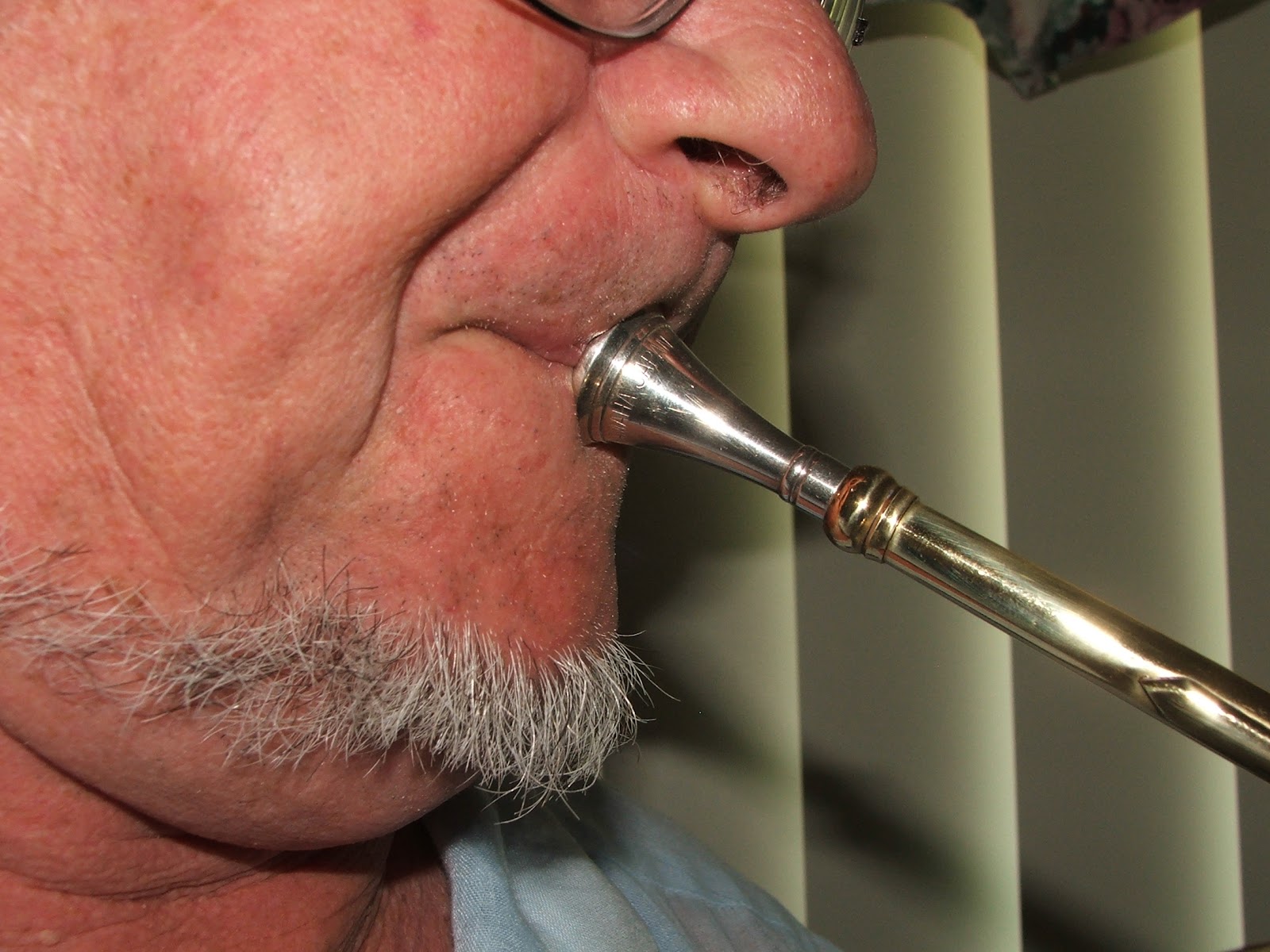
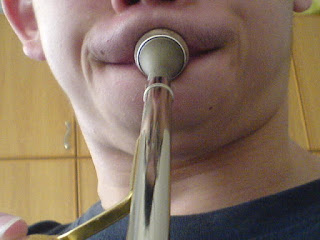
These are still shots of the extreme embouchure settings I use when I practice some of the BE exercises. This is how it works for me:

(1) If I can develop tone, range and facility in an extreme embouchure; then tone, range and facility with a "normal" embouchure will be easier.

(2) If I can learn to play in both extremes, I'm bound to find settings between the extremes that work well for me.

(3) If I systematically practice in the extremes as well as transitioning from one extreme to the other, I'll eventually learn maneuvers I can use to navigate efficiently within the less extreme registers I encounter in daily playing.

Works for me!
Also see:  Why the Extremes?
Also see: "Circus Trick" or Developmental Tool?

-----------------------

The roll-out and roll-in exercises can be performed "correctly" with or without air pockets as seen in the examples contributed by horn players here. Air pockets are an option, not a requirement in BE. Some people can't do the exercises without them; others can't do the exercises with them. It's an individual thing and nothing to stress over either way. I like practicing with air pockets as pictured, because it helps me isolate and control individual muscle groups to play with less overall tension.
--------

"Don't hate me because I'm beautiful!"
-------
Cute comment from Iris: Thanks, Valerie— these pictures are great! I was just joking earlier this week with my daughter (an accomplished trumpet player) that everyone would want to try BE if it was called "X-treme Embouchure!" The photos also helped to show me that I'm on the right track with my goofy-faced ROs and RIs! ~Iris 
----------


If one picture is worth a thousand words, then multiply that by what you see here!


Thursday, July 14, 2011

Dave on Barrows and BE

Dave Stoller, who studied with John Barrows at UW recently wrote. Below is Dave's description of his experiences with John Barrows and BE. For a little background material, see Dave’s testimonial on Jeff’s website from a couple years ago: http://www.trumpetteacher.net/testimonials.html I'm very grateful to Dave for being willing to share his personal insights & experiences. Here are Dave’s words:

Barrows died in 1974 and there was no BE back then. But Callet and Caruso were around in the trumpet world. The horn world at that time was very glued to the Farkas system. Barrow's emphasis was on aperture and total focus of the air stream. He could do things with the air stream and holding one's finger about a foot or two from his chops. You could feel the pin point accuracy of his air stream that far away. He did not like bouncing chins or sloppy chop settings. His focus was so acute it was scary. Barrows was a protege of Wendell Hoss, the leading hornplayer in LA back in the 30's and 40's. Wendell also had this amazing and mind boggling focus. I had the pleasure of playing quartets with him at his house in Glendale CA about 1970. He confessed that Barrows was, arguably, the finest player to pick up the instrument in those years. I wish there was a video of him playing so you could observe what he did with his chops. It was so clinically correct and so incredibly efficient. I just could not get over his virtuosity compared to other major players I heard.

I studied horn with the master of masters, and probably was his worst student ever from a chop standpoint. He took four years to help me develop an embouchure that would work effectively. Then I honed it more as I got into more challenging playing situations. But I have always had slumps when something would go haywire. Or I would have a year where I did not do much playing.

Obviously I could go on and on about all this, but I have given you the salient stuff. And you can post it on your blog since I believe the other hornplayers need to know about Barrows. These are only my observations about him and his teaching.

Only a handful of Barrows students are even around anymore. But I dearly wish you could have seen and heard him play. It was beyond comprehension, but a very different approach - so refined - so elegant that many horn players would not "get it."

Barrows was the true genius of the horn but few players even know about him. Obviously great horn players like Barrows, great brass players in general, have been using many of the universal principals taught in BE, but without formal knowledge of the BE program as Jeff Smiley presents it. What BE does for so many of us is to pull it all together. Yet so much of it is personal and hard to explain.

I can pull out of a slump in 15 minutes with BE. I just run the summary page and take it in about four different keys. It is the best way to open up that range without simply hammering away on high notes. Hammering away never has worked for me and I have to approach all the ranges from a literature standpoint. In other words I have to work the BE around etudes and solo/chamber works, along with orchestral stuff.

For instance, using RI coming down off of the real high licks. I never mastered that until I got into the BE protocol. You must keep the RI (rolled-in setting) going even down into a neutral range. It is almost like we have many little embouchure's and we combine them for what we are doing - subtract some - add some in. I know this sounds loony but it is hard to explain. It is more than muscle memory and allows a soloist to move more freely through very difficult phrases. I cannot imagine playing anymore with the same old chop setup. It’s like being stuck on … ‘chop stupid.’

Some more observations concerning how I apply BE. There are many wicked licks in the standard repertoire and orchestral literature. With BE they simply are not that wicked anymore. For example I might take a solo lick in Mozart and use RI for the whole thing - never relaxing my setting back to neutral. It is like having many little mini computer programs that one uses for the tasks in a piece of music. This is so contrarian to the orthodox world of horn playing/teaching where one uses a very rigid and doctrinaire approach to the music. And this traditional approach robs so many younger players from ever having great high chops.

Apparently I am in RI way more than RO (rolled-out setting). I am naturally in RO because of my classic einsetzen chop setting. It was BE that got me to change much of my chop approach and RI has allowed me to play/perform tunes that I have never done before in public. Yet I cannot explain this to someone who is not grounded in BE.

If there is one salient point about BE, it is that BE gives the player permission to be who they are, and not have to reinvent the wheel to be a second rate copy of someone else. I guess I can draw a parallel to one of the great lady golfers since they are having their US Open here at the Broadmoor Hotel Complex. Few people have the gift of the perfect swing and perfect physique to be a lady golfer, nor the innate talent that separates someone from the rest of the pack. But one can take what they have and use it to the best of their ability. That is the essence of BE from my perspective.

Gotta go, Dave

After reading this article, Eric Johnson added:

For what it is worth. I heard John Barrows play at an International Horn Society workshop in the 70's. He played the Hindemith Horn Sonata, and a couple of Alec Wilder's works as well. At that time he was retired from the University of Wisconsin. He still sounded great and, as usual, his wife was his accompanist.

He did a lot of his recordings on a very old Schmidt Horn. However when that instrument finally died, he went to a Holton H-177 (the 178, only in nickel silver) He always said: "the Holton plays close to the old Schmidt and does everything I need a Horn to do. What more could one ask for!"

The Holton was what he was playing at the time of the workshop.

Thanks to Dave for the testimonial & to Eric for sharing his experiences.
Go back home.

Monday, April 12, 2010

Knowing, Understanding vs Feeling

I learn so much from my BE horn friends. Read this interesting comment from Gill [italics added].

Dear Val,

Yesterday evening, I went through a nice experience. I was trying a couple of BE things on my trumpet, without any real other aim but having some fun after my day at work, and I suddenly found a lip set up (I'd say, 90% of RO and 10% of RI) which allowed me to hit high Cs one after the other with absolutely no mpc pressure while doing RO#4. I knew from my previous experiments on the horn that I was more of a RO type of player, but up till now it was another kind of RO feeling... Yesterday I felt for the first time the foreward - inward motion of RO up to high C and the
repetition made me feel what happens on low C that I need to drag up so I can climb up there easily.

"Muscles moving toward the mpc while ascending." I surely knew and understood what it was about and I already had a kind of feeling before. But now it's a whole new feeling associated with it. There a huge difference between understanding the principals of embouchure development and feeling them.

You can understand the concepts, but it will be nothing until you feel them in practice, and the path is quite well hidden.

...the one solution: "practice", and the first rule: "BE patient!"

Take care.
Gill


If any of you have a trumpet or another brass instrument, it can be beneficial to experiment on it. Experimenting on an unfamiliar brass instrument removes the elements that are unique to the instrument and gives you the opportunity to isolate and explore the universal principals that BE is based upon. After I'd studied BE on horn for a year or more, I began to experiment with BE on trumpet. I discovered a whole new, extreme technique for double pedals with the lower lip fully outside the mouthpiece. I had read the book, knew & understood the logic behind it, but, like Gill, I hadn't felt it yet. Experiencing the new technique on trumpet introduced me to a whole new feeling that wasn't available to me on horn alone. I was able to transfer the techniques to horn and expand on my range of motion that is so beneficial to development.

Valerie Wells